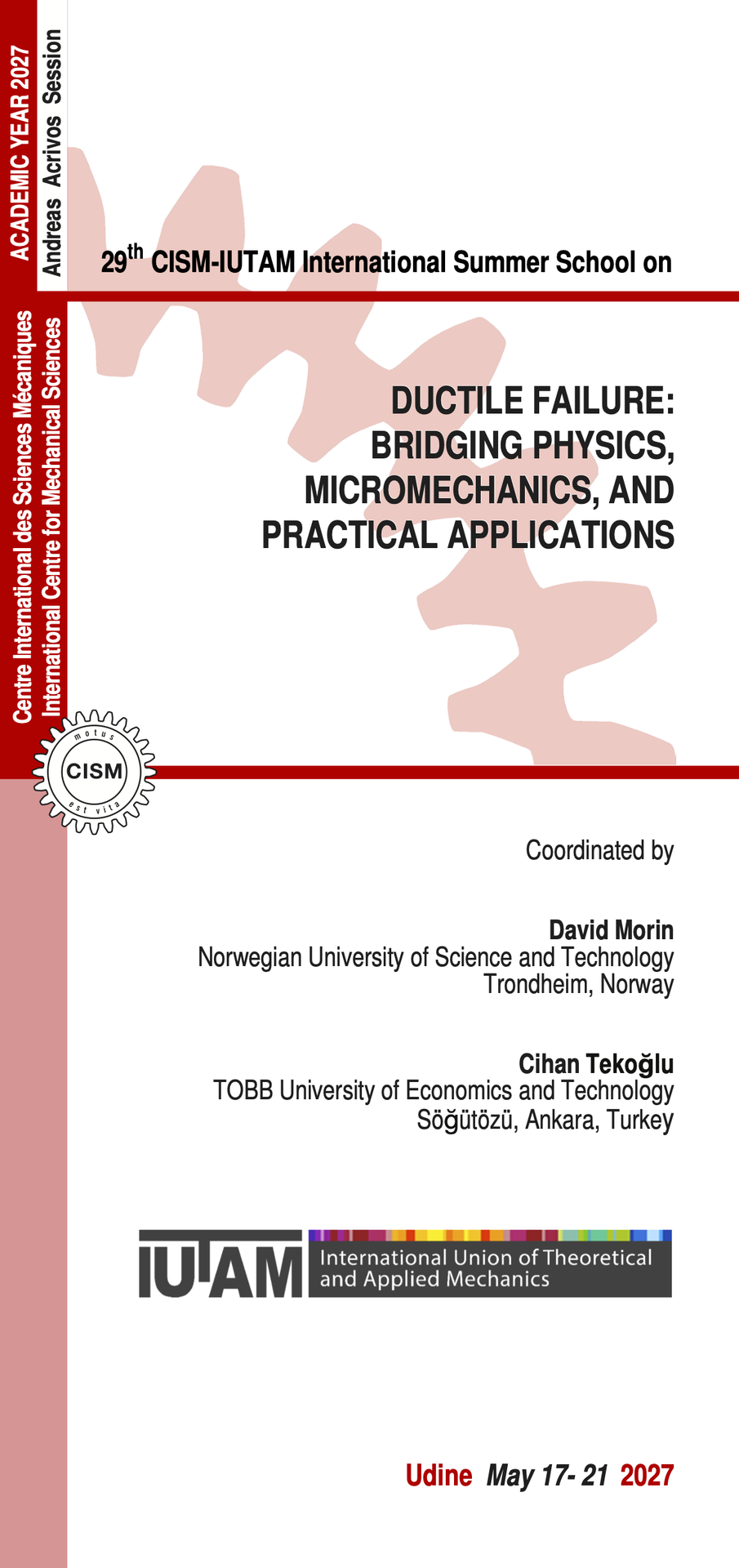
Ductile Failure: Bridging Physics, Micromechanics, and Practical Applications
This course will address recent advances in ductile failure of structural metals, with emphasis on connecting theoretical developments, experimental observations, and engineering applications. Recent advances in experimental characterization, computational methods, and high-performance computing have transformed the field. X-ray computed tomography, for example, enables 3D observation of damage evolution, while modern finite element and constitutive modeling increasingly incorporate microstructural information into predictive frameworks.
The course will provide an overview of ductile failure, from fundamental concepts to current research topics. It is primarily intended for PhD candidates, postdoctoral researchers, and early-career scientists seeking deeper knowledge of failure mechanisms, experimental methods, and computational modeling.
The curriculum will cover six interconnected topics:
1. Phenomenological aspects and experimental observations
Experimental observations of ductile failure under quasi-static and dynamic loading will be reviewed, with emphasis on the effects of stress state, strain rate, and microstructural heterogeneity. Mechanical testing and modern characterization techniques, including X-ray tomography, will provide the physical basis for subsequent modeling approaches.
2. Constitutive and micromechanical approaches to ductile failure
Following a review of finite-strain plasticity, different approaches to ductile failure modeling will be introduced, including uncoupled fracture models, continuum damage mechanics, and porous plasticity together with micromechanical approaches such as unit-cell simulations and homogenization.
3. Localization phenomena and failure mechanisms
The course will address plastic flow localization preceding fracture, including necking, shear banding, and void coalescence. Bifurcation analysis and imperfection band approaches will be introduced and discussed.
4. Length-scale effects and regularization strategies
Because strain localization can lead to mesh-dependent numerical predictions, approaches for introducing intrinsic length scales will be presented. These include non-local damage models, and phase-field methods, with emphasis on their theoretical foundations and practical implications.
5. Computational aspects and numerical implementation
Computational modeling of ductile failure using nonlinear finite element methods will form an important part of the course. Implicit and explicit solution strategies and the implementation of constitutive models through user-defined subroutines (e.g., UMAT/VUMAT) will be addressed through illustrative examples.
6. Multiscale modeling and crack propagation
Finally, the course will address crack initiation and propagation as multiscale phenomena linking microscopic damage mechanisms to structural failure. Micromechanics-informed and gradient-enhanced approaches will be presented, and applied towards engineering-scale fracture predictions.
Overall, the course integrates experimental observations, theoretical modeling, and computational implementation to provide participants with a coherent framework for understanding and predicting ductile failure in structural metals.